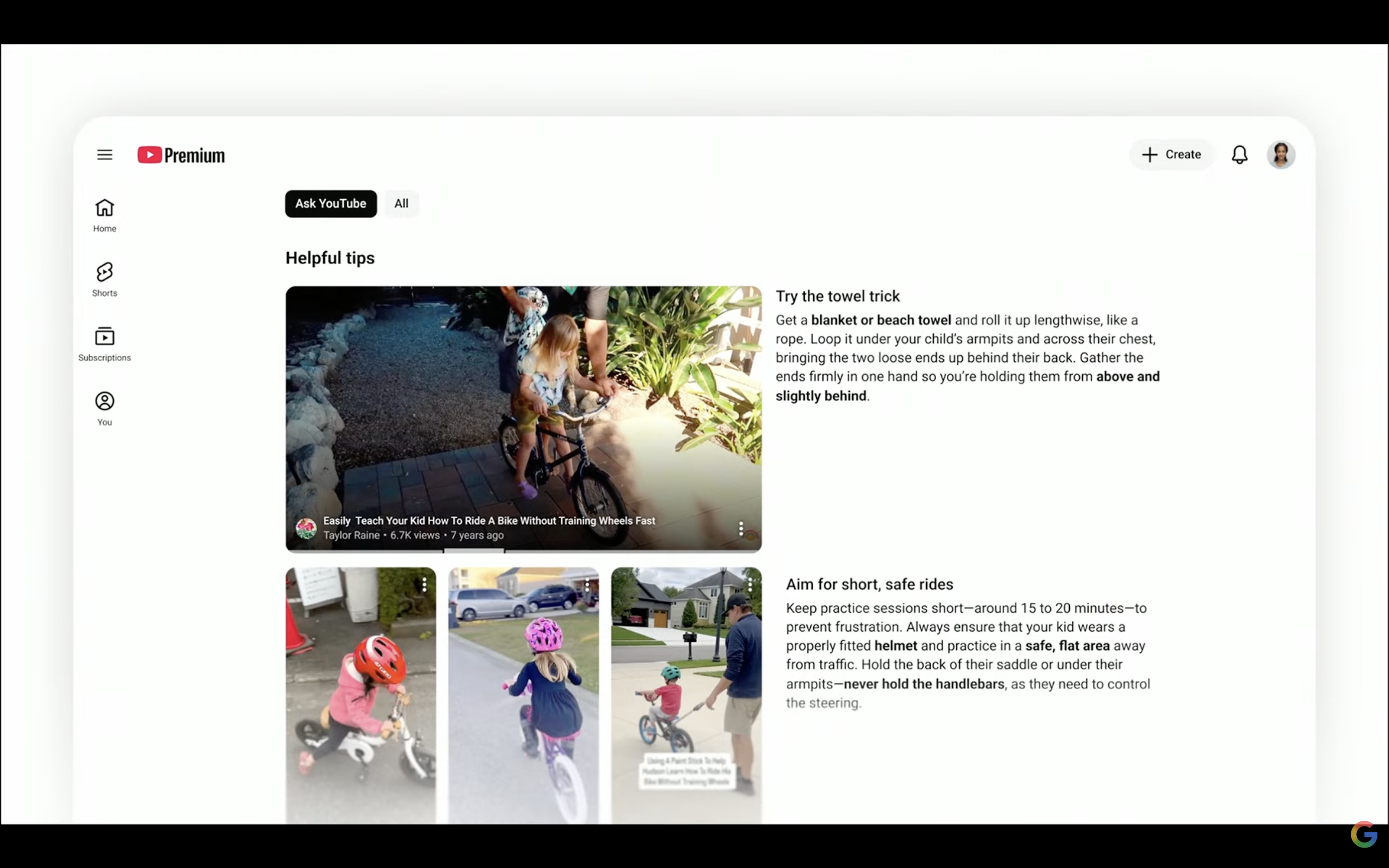
At Google I/O, while most people focused on Gemini demos and AI Overviews, one feature quietly signaled where the internet is actually heading next:
“Ask YouTube”
This is much bigger than a YouTube feature.
This is the beginning of:
- conversational video search
- AI-native discovery
- multi-modal retrieval systems
- intent-driven interfaces
- real-time semantic understanding at planetary scale
And if you work in:
- AI
- Mobile Apps
- Backend Systems
- Search Infrastructure
- Product Engineering
- Recommendation Systems
- Security Engineering
…you should be paying very close attention.
Insights
1. Google is turning YouTube into a queryable intelligence engine
The demo showed users asking:
“Should I buy one with hand brakes or pedal brakes?”
Notice what’s happening here.
Users are no longer:
- typing keywords
- opening 20 videos
- manually extracting answers
Instead:
- AI understands intent
- scans contextual video knowledge
- synthesizes insights
- returns direct recommendations
This changes search fundamentally.
Search is evolving from:
Information Retrieval
to:
Decision Infrastructure
That is a massive platform shift.
Screenshots
The UI looks simple.
The infrastructure behind it is absolutely not.
2. The real innovation is happening underneath the interface
Most discussions online are focused on the UX.
Engineers should focus on the systems architecture required to make this work globally.
To power “Ask YouTube,” Google likely needs:
Multi-modal indexing pipelines
Not just:
- titles
- descriptions
- metadata
But:
- speech recognition
- frame-level computer vision
- OCR extraction
- semantic chunking
- embedding generation
- temporal segmentation
This effectively transforms YouTube into one of the largest vector databases on Earth.
3. Performance engineering becomes mission critical
Conversational systems fail instantly if latency feels slow.
Now imagine delivering:
- semantic retrieval
- contextual reasoning
- ranking
- inference
- summarization
Across:
- billions of videos
- multiple languages
- global traffic patterns
…in near real time.
This introduces massive engineering complexity around:
- GPU inference optimization
- distributed vector retrieval
- ranking fusion
- caching strategies
- edge acceleration
- memory efficiency
- token optimization
- retrieval latency reduction
This is not just AI.
This is elite-scale distributed systems engineering.
4. Security and trust become first-class engineering domains
This is where things become extremely important.
If AI summarizes creator content incorrectly:
- misinformation spreads
- creators lose trust
- legal exposure increases
- manipulation risks rise
So Google now needs:
- hallucination mitigation systems
- source attribution pipelines
- trust scoring layers
- adversarial prompt defenses
- policy-aware ranking systems
- contextual validation frameworks
The next generation of AI products will not win on intelligence alone.
They will win on:
- reliability
- security
- factual grounding
- trust architecture
This is the future of Security Engineering in AI systems.
5. Mobile apps are about to change completely
This trend impacts mobile architecture more than most developers realize.
Traditional apps were built around:
Screens → Navigation → Menus → Workflows
AI-native apps will move toward:
Intent → Interpretation → Execution
Meaning:
- fewer screens
- less navigation friction
- conversational orchestration
- retrieval-driven experiences
- adaptive interfaces
This changes:
- app architecture
- API design
- analytics systems
- observability pipelines
- caching models
- personalization engines
The winners in mobile won’t just build apps anymore.
They’ll build:
- intelligence layers
- orchestration systems
- context-aware experiences
Key Takeaways
1. Search is becoming conversational infrastructure
The future of search is not links.
It’s AI-assisted decision making.
2. Multi-modal AI is the next platform war
Text alone is no longer enough.
The next generation of systems will understand:
- video
- audio
- images
- context
- behavior
- intent
simultaneously.
3. Security Engineering is now an AI problem
Hallucination prevention, trust scoring, adversarial defense, and attribution systems are becoming core product infrastructure.
4. Performance will define AI product winners
The best AI product is not the smartest one.
It’s the one that:
- feels instant
- scales globally
- maintains trust
- minimizes hallucinations
- delivers reliable context
5. AI is eliminating interaction friction
The biggest opportunity in tech right now is reducing:
- navigation
- search fatigue
- discovery overhead
- decision latency
That is exactly what Google is building toward.
Final Thought
Google is no longer building “features.”
They are rebuilding the interaction model of the internet itself.
And “Ask YouTube” may quietly become one of the most important AI product shifts announced at Google I/O.
Most people saw a demo.
Engineers should see:
- retrieval systems
- semantic infrastructure
- AI orchestration
- distributed inference
- trust engineering
- the future of software architecture
I’ll be breaking down more Google I/O announcements from:
- AI Infrastructure
- Mobile Engineering
- Android Architecture
- Performance Systems
- Backend Scalability
- Security Engineering
- Product Strategy
Follow for deep technical + product-level analysis on where AI-native software is actually heading.
#GoogleIO #ArtificialIntelligence #YouTube #GenerativeAI #AI #SoftwareEngineering #SystemDesign #MobileDevelopment #AndroidDev #BackendEngineering #PerformanceEngineering #SecurityEngineering #LLM #Search #ProductEngineering #MachineLearning #Scalability #TechLeadership #AIProducts #DistributedSystems #FutureOfSearch