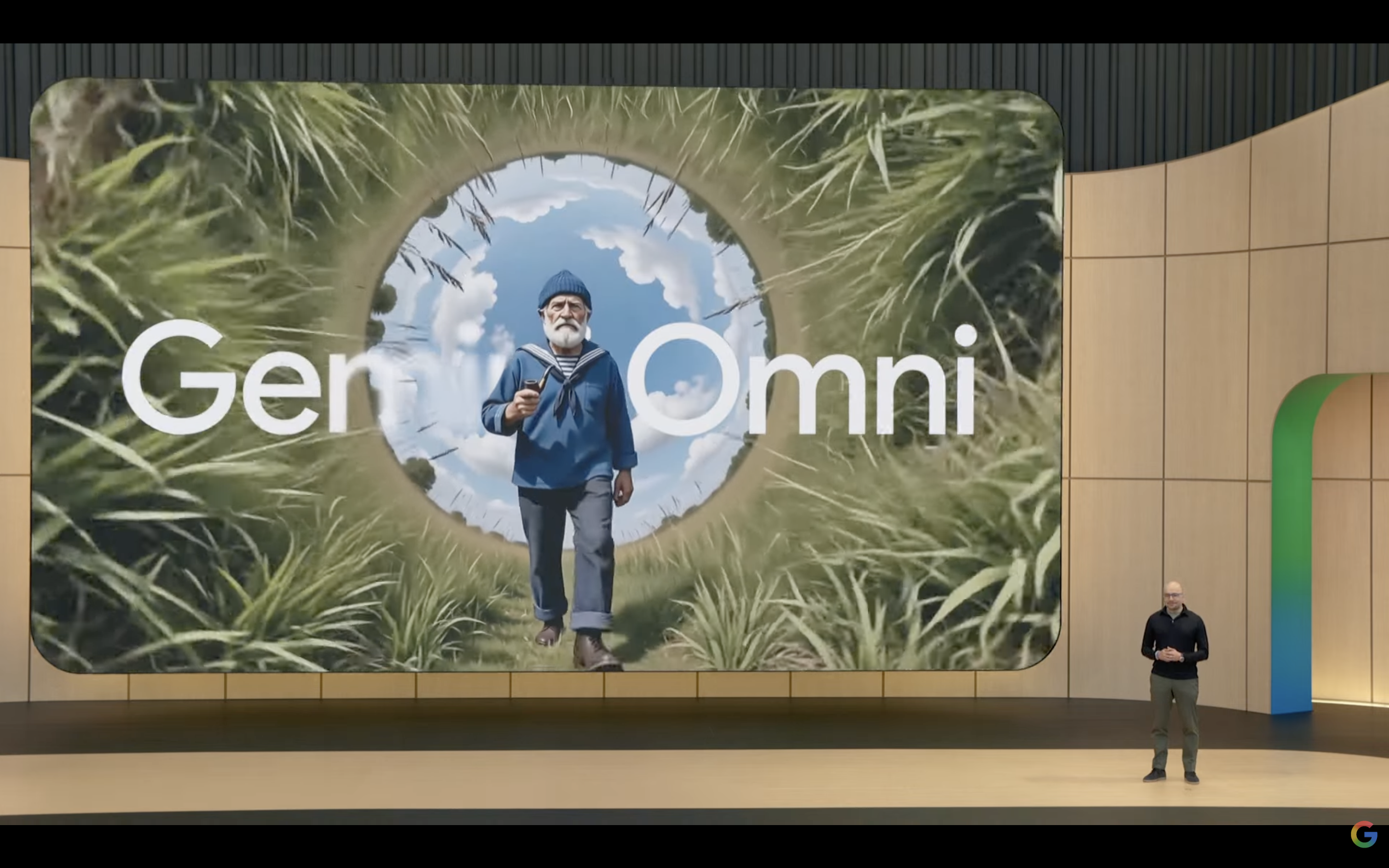
Google just crossed a line at I/O that changes the future of AI forever.
It’s called:
Gemini Omni Flash
And this is no longer “AI generating content.”
This is AI altering reality itself.
At Google I/O, Google demonstrated a new generation of multimodal AI capable of:
- swapping objects in real time
- transforming environments
- generating entirely new visual realities
- understanding context instantly
- modifying scenes naturally
- blending physical and synthetic worlds seamlessly
Most people saw cool demos.
Engineers should see the beginning of:
- real-time world simulation
- generative reality engines
- AI-native rendering pipelines
- multimodal reasoning systems
- synthetic media infrastructure at scale
And the implications for:
- mobile apps
- security
- social media
- gaming
- advertising
- filmmaking
- ecommerce
- trust systems
…are absolutely massive.
Insights
1. Gemini Omni Flash changes AI from “generation” → “manipulation”
Previous AI models generated:
- text
- images
- code
- video
Gemini Omni Flash goes further.
It understands and modifies:
- scenes
- objects
- environments
- perspective
- lighting
- context
- spatial relationships
In real time.
That is a fundamental platform shift.
We are moving from:
Generative AI
to:
Reality-Oriented Computing
This changes the software industry completely.
The demos looked cinematic.
But the real breakthrough is the engineering architecture underneath.
2. Real-time multimodal inference is now becoming production-grade
To make Gemini Omni Flash work at scale, Google likely built an enormous multimodal infrastructure stack combining:
Vision Models
Understanding:
- objects
- humans
- motion
- depth
- environments
- semantics
Language Models
Interpreting:
- intent
- prompts
- conversational context
- natural language instructions
Generative Rendering Pipelines
Creating:
- photorealistic transformations
- object swaps
- scene consistency
- lighting adaptation
- temporal continuity
Spatial Reasoning Systems
Maintaining:
- geometry
- perspective
- environmental realism
- object permanence
- contextual accuracy
This is no longer “just AI.”
This is a new compute paradigm.
3. Performance engineering becomes the entire product
None of this works if latency feels slow.
Users expect:
- instant rendering
- real-time interaction
- frame consistency
- ultra-low inference latency
Which means Google is likely optimizing:
- edge inference
- GPU scheduling
- tensor acceleration
- multimodal caching
- memory compression
- token routing
- model quantization
- distributed rendering pipelines
This is elite-scale systems engineering.
The companies that solve:
- latency
- bandwidth
- inference cost
- GPU efficiency
…will dominate the next generation of AI platforms.
4. Security implications are enormous
This is where things become extremely serious.
If AI can:
- alter environments
- manipulate objects
- generate photorealistic reality
- simulate humans
- modify live visuals
Then security becomes a first-class AI infrastructure problem.
The risks include:
- synthetic misinformation
- identity spoofing
- visual manipulation attacks
- trust erosion
- deepfake escalation
- adversarial media injection
Which means future AI systems will require:
- provenance tracking
- cryptographic authenticity
- watermarking pipelines
- real-time content verification
- AI-generated media detection
- trust-layer architectures
The future of cybersecurity is becoming deeply tied to generative AI.
5. Mobile apps are about to evolve beyond interfaces
This announcement matters massively for mobile developers.
Why?
Because mobile apps are moving toward:
Camera-first AI experiences
Where users no longer:
- browse menus
- upload files manually
- navigate workflows
Instead they simply:
- point
- ask
- modify
- generate
- interact naturally
The future UX becomes:
Real-world input → AI reasoning → Instant transformation
This changes:
- app architecture
- rendering systems
- backend infrastructure
- API orchestration
- GPU optimization
- device compute models
The next billion-dollar apps will not look like traditional apps.
They’ll feel like intelligent reality layers.
Key Takeaways
1. AI is evolving into a real-time world engine
This is no longer static content generation.
AI is becoming capable of:
- understanding reality
- modifying reality
- generating synthetic experiences dynamically
2. Multimodal infrastructure is the next cloud war
The next hyperscaler battle will revolve around:
- GPU infrastructure
- inference optimization
- multimodal pipelines
- distributed rendering
- edge AI acceleration
3. Security engineering becomes mission critical
As AI-generated reality becomes indistinguishable from real media:
- authenticity
- verification
- provenance
- trust systems
…become core infrastructure layers.
4. Performance will determine winners
The best AI product will not necessarily be the smartest.
It will be the one that:
- feels instant
- scales globally
- minimizes hallucinations
- maintains realism
- delivers trusted output consistently
5. The UI era is slowly ending
We are moving from:
- app interfaces
- buttons
- workflows
Toward:
- conversational interaction
- camera-driven computing
- AI-native environments
- contextual reality systems
This is one of the biggest shifts in software history.
Final Thought
Most people watched the Gemini Omni Flash demo and saw entertainment.
Engineers should see:
- the future of compute
- the future of rendering
- the future of security
- the future of mobile
- the future of interaction design
Google is no longer building AI assistants.
They are building:
programmable reality infrastructure.
And that changes everything.
I’ll be breaking down more Google I/O announcements from the perspective of:
- AI Infrastructure
- Android Engineering
- Mobile Architecture
- Backend Scalability
- GPU Systems
- Security Engineering
- Performance Optimization
- Product Strategy
Follow for deep technical + strategic analysis on where AI-native software is heading next.
#GoogleIO #Gemini #ArtificialIntelligence #GenerativeAI #MultimodalAI #MachineLearning #SoftwareEngineering #SystemDesign #MobileDevelopment #AndroidDev #SecurityEngineering #PerformanceEngineering #AIInfrastructure #LLM #DeepLearning #CyberSecurity #FutureOfAI #DistributedSystems #TechLeadership #ProductEngineering #ComputerVision #AIProducts